Aaron Lionheart

Software engineer in Perth, Western Australia, and CEO of Lionheart Global Corporation.
Years in C# and .NET
18yrs
Professional years writing C# and .NET, as listed in the skills matrix on the resume. C and C++ go back just as far.
Work
Eleven roles since 2017: eight across six enterprise clients, and three games from my own studios.
I'm a software engineer in Perth, Western Australia, and the CEO of Lionheart Global Corporation. I've built for the University of Western Australia, BHP, Rio Tinto, Squiz, Bunnings and LiveMine, and I release my own software alongside: two games out on Steam, one in development, and the MIT-licensed tools I use every day.

UWA
Full stack lead, Digital Experience. Sep 2025 - Present.
Full stack lead in the Digital Experience team, delivering frontend, backend and infrastructure across the university's web platforms, student systems and security tooling.
- Delivered the first stage of the new student portal backend, covering architecture, infrastructure and code, built to scale with Redis. It integrates Callista, Blackboard, Entra ID SSO and other university systems.
- Mentored interns to turn their vision into a student portal prototype. When it was presented to wider University IT, it won buy-in for the new student portal.
- Architected and delivered a zero-downtime migration of university search from Funnelback to Sitecore Search using a strangler fig pattern, covering the search UI, Cloudflare Workers and Azure API Management.
- Built an automated vulnerability management platform covering 42 repositories. It scans daily, feeds a bespoke dashboard I built for managing the whole portfolio, and sends weekly reports supporting Essential Eight compliance.
- Developing AI-driven CVE remediation on Microsoft Foundry, which fixes and verifies vulnerabilities and raises pull requests for review.
- Built and maintain frontend components for www.uwa.edu.au on Sitecore XM Cloud with React, Next.js and Vercel, along with its deployment pipelines and branching strategy.
- Rebuilt and upgraded the team's build agents and CI/CD pipelines, and automated software updates across the build infrastructure.
- Ran security audits and built AI-assisted auditing tools with Microsoft Copilot.
- Presented on Essential Eight compliance and security automation to IT staff.
- Winner of the Uni IT Architectural Patterns Competition 2026.
- And much more.
C#, ASP.NET Core, React, Next.js, TypeScript, Redis, Microsoft Azure, Azure API Management, Microsoft Entra ID, Cloudflare Workers, Sitecore XM Cloud, Sitecore Search, Vercel, Docker, Kubernetes, DevOps, DevSecOps, Microsoft Foundry, AI Agents
UWA
Cloud migration and modernization. Oct 2024 - Dec 2024.
Migrated multiple on-premises solutions to the cloud with improvements and code rewrites. This includes the Student Recharge app, where UWA students add value to their student cards online; the Password Update portal, and various other critical university services.
JavaScript, Razor, C#, HTML, CSS, Git, SQL, Xetta Payment Integration, SendGrid Email Integration, Azure DevOps

BHP
Mine shutdown reporting dashboard. Feb 2024 - Sep 2024.
Worked on creating a new dashboard solution for BHP mine shutdowns that pulls data from 3 different systems and displays a dashboard for quick decision making based on stakeholder metrics, implementing both the front-end and back-end.
JavaScript, React, C#, HTML, CSS, Git, SQL, Snowflake, GitHub

Rio Tinto
Rail system tracking and reporting. July 2023 - Nov 2023.
Worked on stabilizing and improving the rail system tracking, reporting, and location services on both the front-end and back-end.
F#, C#, React, Git, Unit Testing, SQL, CI/CD, Power BI Integration, BitBucket
BHP
Shipping optimization on the PRISM squad. Jan 2023 - May 2023.
Part of the PRISM Squad working on mining industry shipping related optimization solutions, implementing new features on both the front-end and back-end.
JavaScript, Angular, C#, HTML, CSS, Git, Unit Testing, SQL, CI/CD, Azure Logic Applications, Power BI Integration, Snowflake, BitBucket

Squiz
Lead developer, Squiz Workplace. Jan 2022 - Nov 2022.
Part of the Plug & Play Squad. Took over as lead developer of the Squiz Workplace product, in charge of implementing new features, bug fixes, client patches and releases.
JavaScript, React, Angular, PHP, HTML, CSS, Git, Cypress, Unit Testing, SQL, CI/CD, Azure, AWS, Azure Logic Applications, GitHub

Bunnings
Self-checkout and logistics management. Jan 2021 - Jan 2022.
Part of the MS Front End React Squad, creating new projects from scratch with modern React, Redux-Saga, TypeScript, styled-components etc. As well as updating old projects in our domain, API side included. Performing stakeholder meetings, showcases, engaging with business developers etc. Main projects include "Self Checkout" and "Logistics Management App".
C#, DotNet Core, Angular, React, BitBucket

Heroes Raid
Always-online 3D action RPG. 2021 - In Progress.
Building Heroes Raid, an always-online 3D action RPG set in a dark, dystopian world of angels, demons, firearms, swordsmanship, magic and advanced technology. It's on Steam ahead of release, with alpha testing running through Discord. The game talks to its API server constantly and is built to scale to millions of players, with free-to-play monetisation and a new-content-every-week model.
- A story told in acts, from a dream above a rain-soaked city to an escape from armed soldiers on a train, with cutscenes along the way, and dungeon raids generated procedurally so no two runs are the same.
- Play solo or in online co-op, with a squad whose AI can be set to specific tactics.
- Equipment is summoned and grants abilities to upgrade and master; sacrificing a summoned hero passes its abilities to another, for builds from a lightning-fast assassin to a magic-wielding archer.
- A PvP arena with 4v4, 3v3, 2v2 and 1v1 modes, ladders, fame and rewards, and cross-platform multiplayer.
- Loot, levels and rewards throughout, with in-app purchases, and the game localised into 26 languages.
C#, DotNet Core, Unity Engine, Unit Testing, SQL, Azure, Azure Logic Applications, AWS, CI/CD, Git, React, Analytics Integration

SquareCode / LiveMine
Shift management and worker co-ordination. Jan 2019 - Dec 2021.
Worked primarily on LiveMine. Clients use LiveMine for mine-specific shift management, big data and worker co-ordination. I worked very closely with the LiveMine team spending a few months in their Fremantle office.
C#, Xamarin, Angular, React, HTML, CSS, Git, SQL, Analytics Integration, Power BI Integration

Super Friends Party
Six-player online party game. Jan 2018 - Jan 2019.
Built and released Super Friends Party, a free-to-play online party game on Steam where up to six players, friends or strangers, battle through minigames to find a champion. It opened in Early Access in June 2019 and had its full release in August 2026.
- Minigames spanning dozens of genres, designed with the feel of classic old-school party games.
- Online play through solo-queue matchmaking or custom lobbies with friends, on an always-online backend that also holds each player's inventory.
- Over 100 playable characters and hundreds of unlocks, with names and appearances that can be changed at any time.
- Tickets earned by playing buy hats, taunts, characters and more, alongside in-app purchases.
- A live-service model with regular content updates: new minigames, characters, hats and taunts.
C#, Unity Engine, Unit Testing, SQL, Azure, AWS, CI/CD, Git

Grand Battle
Ten-character action RPG. Jan 2017 - Jan 2018.
Built and released Grand Battle, a free-to-play action RPG on Steam. A meteor strike brings monsters to the planet, and a party of heroes fights across themed areas to find out why. Up to four friends can play together on one screen.
- Ten playable heroes across nine classes, from Great Axe and Sword Master to Staff Magic, Elemental Golem and Bow & Arrow, each with its own combat style.
- A party of four with instant switching between heroes, and AI party members whose behaviour the player can configure.
- Local split-screen co-op and PvP for up to four players, with full XInput controller support.
- Over 100 quests, monsters that drop crafting materials for upgrading equipment, and gear that grants abilities and changes how each hero fights.
- Shipped on Steam with achievements, Remote Play Together and Family Sharing, plus a paid item pack DLC.
C#, Unity Engine, Steamworks, Unit Testing, CI/CD, Git
What I do
AI on the device
Local AI that runs on the machine in front of you rather than on someone else's server. On-device LLM inference with ONNX Runtime GenAI, long-term memory for agents built on embeddings and hybrid search, and compiler-driven code intelligence from Roslyn and the TypeScript compiler, all served to coding agents over the Model Context Protocol.
Speech in both directions: GPU text-to-speech with zero-shot voice cloning, returning word and viseme timings so a character can lip-sync to it, and whisper.cpp for recognition. Audio models too, for stem separation and pitch transcription. Where a cloud model is the right call, Claude, OpenAI, Gemini and Grok sit behind one interface.
I work with AI agents every day as well: Claude Code, Agent Skills and project instructions that let them work across a whole codebase to the same standard I do.
- Phi-4-mini on ONNX Runtime GenAI, int4, 128K context
- MiniLM embeddings with BM25F and trigram hybrid retrieval
- MCP servers in C# and Rust
- F5-TTS voice cloning, KittenTTS and eSpeak NG
- whisper.cpp speech recognition
- CUDA, TensorRT and DirectML execution providers
- HT-Demucs stem separation and Basic Pitch transcription
- Claude, OpenAI, Gemini and xAI APIs
Apps and open source
Mobile apps for iOS and Android in React Native and Expo, on the New Architecture and in strict TypeScript: offline-first with on-device SQLite and persisted queries, built to keep working and keep data intact when the network doesn't, with App Store subscriptions, push notifications and seven languages, shipped through EAS and TestFlight. Native Android in Kotlin and Jetpack Compose when the platform calls for it.
Desktop apps in Electron with React, and in Avalonia on .NET, where one executable is both the app and its command-line tool. Each ships with real installers for every platform: WiX MSI on Windows, signed and notarised DMGs on macOS, .deb and AppImage on Linux, and Steam builds.
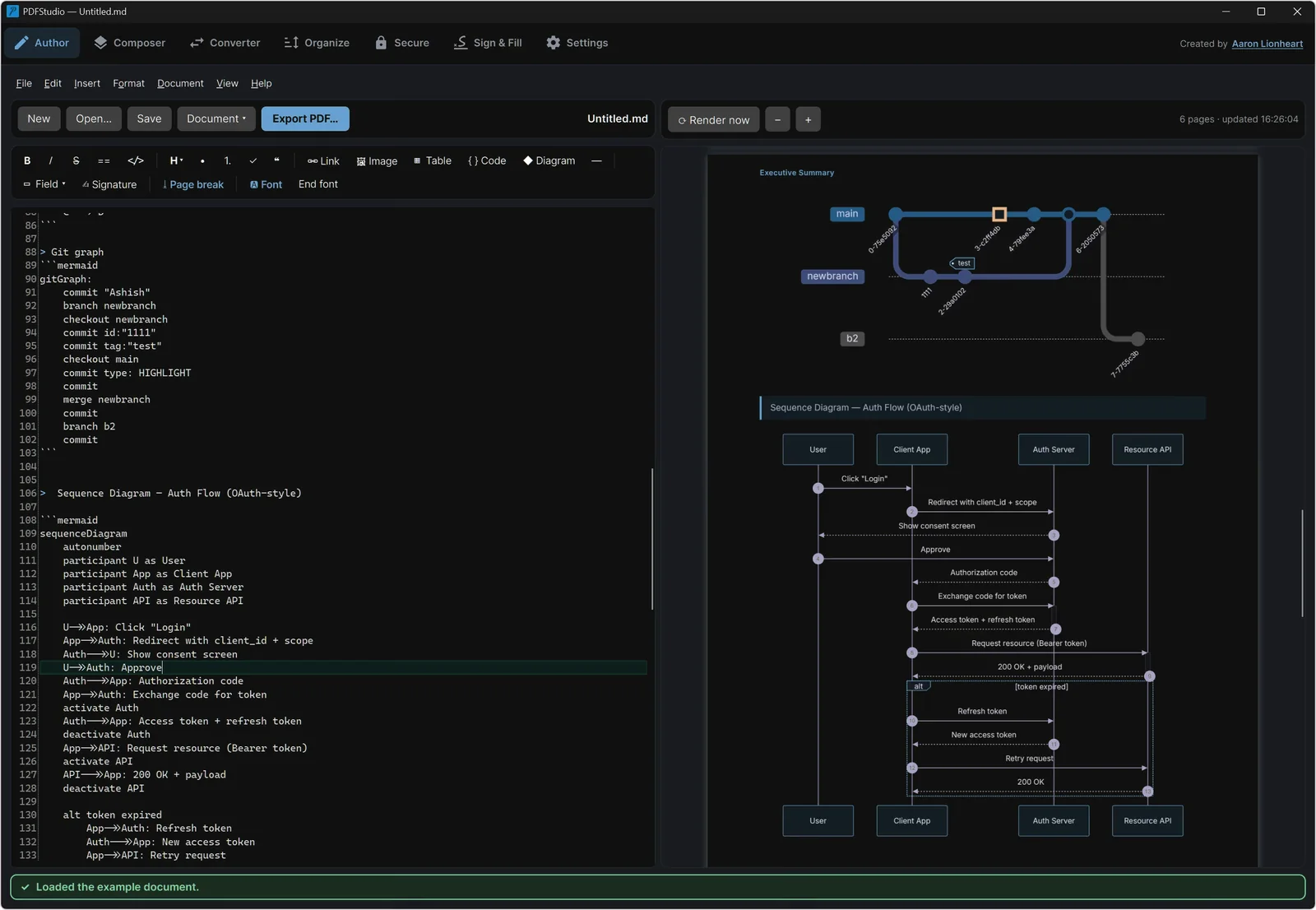
I build and release my own tools under the MIT license for anyone to use, including PDFStudio, Agentic Memory and Windows Audio Recorder, three projects I actively maintain in public.
- React Native 0.83 and Expo SDK 55
- Zustand, TanStack Query, Reanimated and Zod
- EAS Build, TestFlight and App Store subscriptions
- Kotlin, Jetpack Compose and Android TV
- Electron and React; Avalonia, WinForms and XAML
- Xamarin for iOS and Android before that
- WiX, notarised DMGs, .deb, AppImage and Steam
- MIT licence, no telemetry
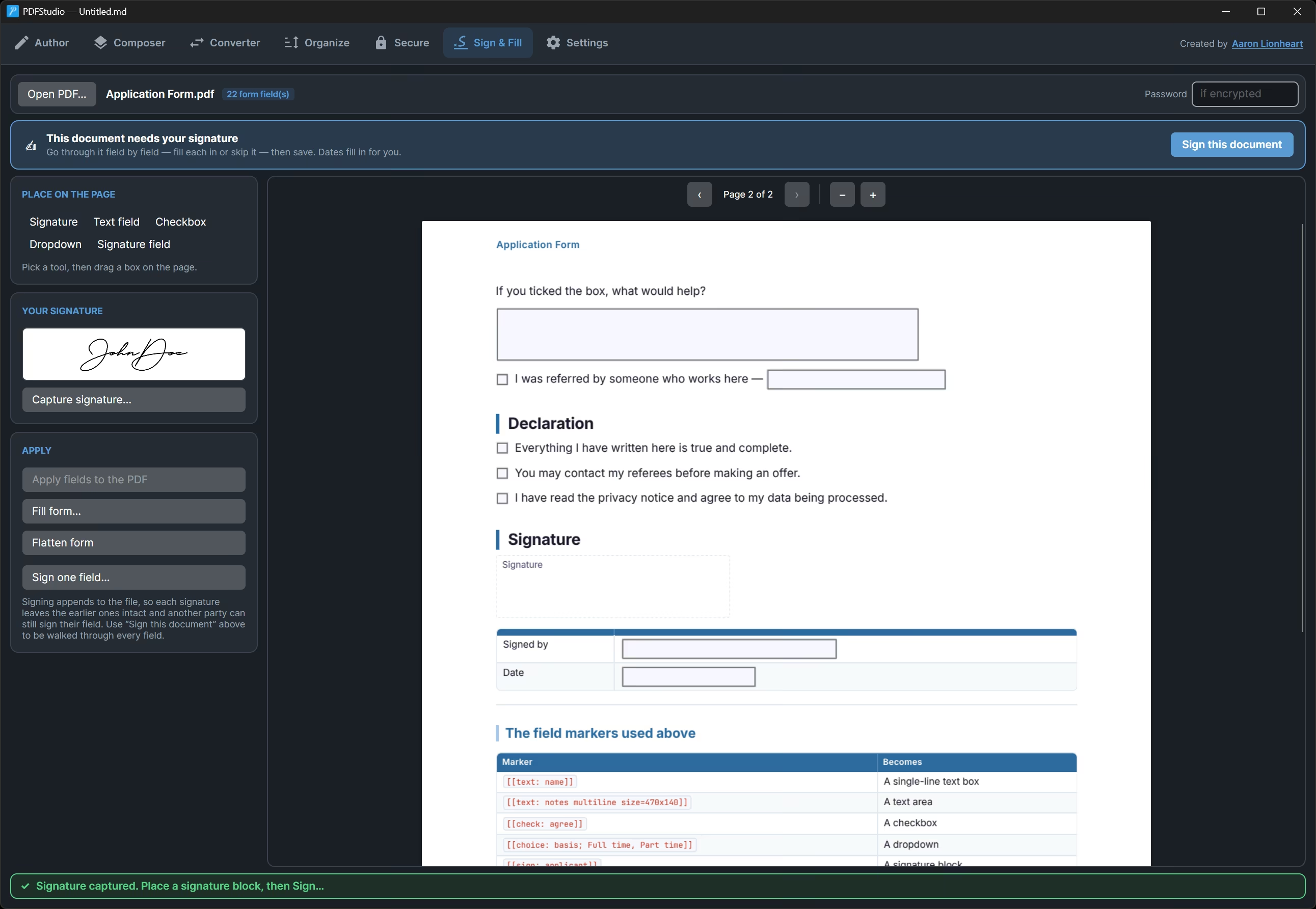
3D and games
Real-time 3D in Unity since 2017, across three games of my own: from the gameplay and rendering math to the asset pipeline that gets art into the engine without breaking, and the networking that keeps players in step.
On the web and the desktop, three.js and React Three Fiber: animated 3D characters with spring-bone physics, retargeted animation and lip-sync driven by speech, compressed GPU textures, and instanced WebGL views that keep thousands of objects at frame rate. Every particle scene on this site is a GLSL shader over one cloud of points.
- Unity since 2017, including HDRP
- Gameplay, rendering and physics
- Realtime multiplayer networking
- three.js, React Three Fiber and GLSL
- VRM avatars, spring bones and VRMA animation
- KTX2 and Basis texture pipelines
- Tools for Unreal's .uasset format
- Steam builds and SteamPipe uploads
Back end
APIs and data models built to hold up under real traffic, backed by cloud infrastructure on Azure and AWS rather than a server under someone's desk.
Mostly ASP.NET Core on .NET 10: Entity Framework over SQL Server, background work on Hangfire, JWT and Entra ID single sign-on, OpenAPI documentation and Application Insights, deployed to Azure App Service from GitHub Actions. App Store receipt checks and push notifications, and AI generation done on the server, where its output can be checked before anyone sees it.
Realtime where it counts: a lock-free audio engine in Rust, WebSocket gateways, and multiplayer networking for games.
Comfortable owning a feature end to end: schema, API, UI and the pipeline that ships it. React and Angular on the front, .NET and Node on the back, with the judgement to know which one a problem actually needs.
- C#, F#, ASP.NET Core and .NET 10
- Rust and Node.js services
- SQL Server, Postgres, Snowflake, Redis and SQLite
- Entity Framework and Hangfire
- Microsoft Azure, Entra ID and AWS
- Cloudflare Workers and Turnstile at the edge
- REST, OpenAPI, WebSockets and MCP
Front end
Interfaces people actually enjoy using, from component architecture and state management down to the CSS details that make something feel fast and considered instead of merely functional.
React 19 and strict TypeScript on Vite, rendered on the server or generated ahead of time with Next.js or Vike, with client state in Zustand and server data in TanStack Query. At enterprise scale, Sitecore XM Cloud with Next.js on Vercel, and Angular and Blazor where a team already lives.
Fast is a feature: prerendered pages, image pipelines, search that runs in the browser, WebGL where it earns its place, and every flow tested end to end in a real browser.
- React, Next.js, Vike, Angular and Blazor
- TypeScript, strict
- Vite, Tailwind and SCSS
- Zustand, TanStack Query, React Router and Zod
- Sitecore XM Cloud and Sitecore Search
- Vitest, Playwright and Cypress
Automation and teams
If I do something more than twice, I script it. CI/CD pipelines, build tooling and workflow automation that remove the repetitive parts of shipping software.
Every project I own ships from CI: matrix builds that test, sign and package for Windows, macOS and Linux, mobile builds through EAS, and store and Steam uploads scripted end to end. Code is held to strict rules on the way: clippy and model checking for realtime Rust, and unit and browser tests for everything else. At UWA, daily vulnerability scanning across 42 repositories feeds Essential Eight reporting.
Leading teams that don't need me in the room to function well: clear planning, documentation and feedback loops instead of constant oversight.
- GitHub Actions, Azure DevOps and TeamCity
- Code signing, notarisation and installers
- EAS, TestFlight and SteamCMD pipelines
- Docker and Kubernetes
- DevSecOps and Essential Eight scanning
- AI agents on Microsoft Foundry and Claude Code
- xUnit, Vitest, Playwright, loom and clippy
- Mentoring, planning and documentation
Under the work sits one belief: people should be free to choose, and technology should repair what we inherited.